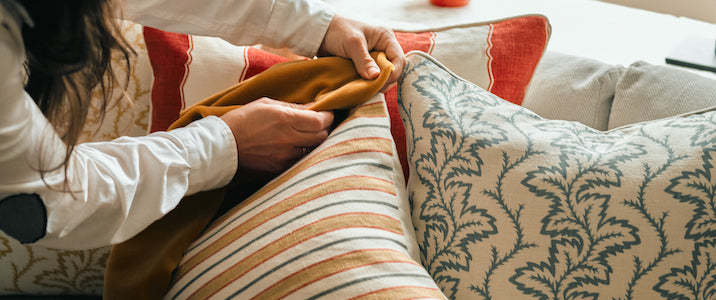
So, you’re thinking about reupholstering. Excellent decision. Before you dive in, here are some important questions (and honest answers) to help you plan properly.
1. How much should I budget to recover/reupholster my sofa?
This depends on the size and complexity of your sofa, but as a guide I saved between £1,000–£2,000 for the labour, plus the cost of fabric on top.
Always ask your local upholsterer for a detailed quote and check that it includes:
-
Collection
-
Delivery
-
Removal of old fabric
-
Any frame or spring repairs
You do not want the logistical headache of moving a large sofa yourself.
It’s also worth asking whether VAT is included — surprises at the end aren’t fun.
2. Is my sofa worth recovering?
This is the big one.
Look at the frame. Does it have good bones? Hardwood frames and traditional joinery are ideal. If it’s solid and structurally sound, it’s almost always worth saving.
If it creaks slightly, that’s not necessarily a deal breaker - springs and webbing can be repaired. But if the frame is made from lightweight composite board and feels unstable, it may not justify the investment.
Recovering works best when you started with a quality piece.
3. How much fabric do I need for my sofa?
It depends on:
-
The size of your sofa
-
The shape and number of cushions
-
Whether it has piping or skirts
-
The pattern repeat of your chosen fabric
As a rough guide, I’d say a minimum of 10 metres for a two-seater sofa.
We used 20 metres of a stripe for our large L-shaped sofa. Patterns with a repeat (especially stripes, florals or geometrics) often require more fabric because everything has to line up beautifully.
Always check with your upholsterer before ordering - they’ll calculate accurately.
4. How do I choose a fabric (and pattern)?
This is where things get interesting.
A few things to consider:
-
Busy patterns hide dirt, marks and everyday life beautifully. If your sofa sits in the heart of family chaos, this is a smart choice.
-
Very dark plain fabrics can actually show dust and marks more than you expect.
-
Mid-tones and textured weaves are forgiving.
-
Stripes can make a sofa feel tailored and smart.
-
Large-scale patterns make more impact on larger sofas — tiny prints can get lost.
-
Always order a sample. Look at it in morning light, evening light, and under lamps.
And ask yourself: do you want this sofa to be the star of the room, or the supporting act?
5. Will my sofa be hard-wearing enough?
Check the Martindale (rub count).
If it’s a hard-working sofa in the centre of your home, I recommend a minimum of 25,000 rubs - and honestly, the higher the better for family life.
Also consider:
-
Is it a tight weave?
-
Does it snag easily?
-
Do you have pets? (Claws and loose weaves are not friends.)
Durability is just as important as aesthetics.
6. Should I choose natural or synthetic fibres?
Personally, I lean towards natural fibres - linen, cotton, wool and avoid adding extra chemicals where possible.
Natural fibres:
-
Age beautifully
-
Breathe better
-
Avoid additional chemical treatments
Synthetics can sometimes offer higher stain resistance, but balance that against environmental impact and personal preference.
7. Do I need to stain guard it?
I tend to avoid additional chemical treatments.
Instead, I make sure:
-
Covers can zip off and be washed
-
Cushion covers are removable
-
Or I add a loose cover that can be thrown in the washing machine
Designing in practicality is often better than spraying on protection.
8. How long will it take?
Reupholstery isn’t instant. Depending on your upholsterer’s workload, it could take several weeks.
Plan ahead - especially if it’s your main sofa. You may need a temporary seating solution. We didn't have a sofa for 3 weeks in total.
9. Do I want to change the shape or just the fabric?
This is your opportunity.
You could:
-
Add deeper cushions
-
Change the firmness of the seat
-
Replace foam with natural fillings
-
Remove a skirt for a more modern look
Sometimes a small tweak makes it feel like an entirely new piece.
10. Am I ready to commit?
Reupholstery is an investment. It’s not fast furniture. But that’s the point.
You’re choosing:
-
Lower environmental impact
-
Better quality
-
Longer lifespan
-
And something personal
Done well, your “new” sofa should last another 10–15 years - maybe longer.
Recovering a sofa isn’t the quickest option. It’s not the cheapest upfront either. But it is one of the most satisfying ways to create a home that reflects your values - thoughtful, lasting and beautifully individual.
If you’ve decided your sofa has good bones and deserves a second life, the fabric you choose will make all the difference. Take your time, order samples, live with them for a few days and see how they feel in your space.
When you’re ready, explore our collection of upholstery fabrics - carefully chosen for durability, character and longevity and find the one that will carry your sofa (and your home) into its next chapter.