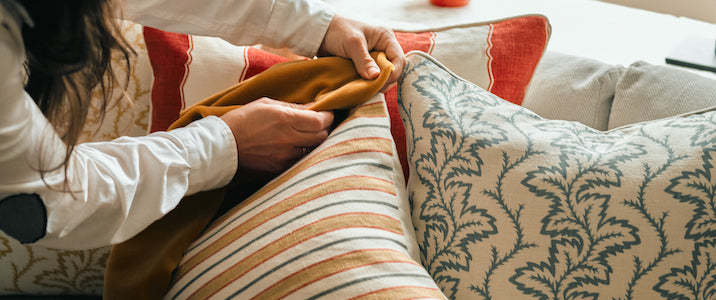
Natasha Hulse is an appliqué artist specialising in bespoke artworks for headboards, wallpaper, fabric walling and interior products. Natasha makes everything by hand, painting murals onto paper and fabric and then adding three dimensional applique artworks that are then sewn and applied around a room. We sat down with Natasha to lean more about her work, inspirations and advice for starting a creative business. Keep reading to find out more!

Image by: Jack Davolio
How did you first get into appliqué and textile art and why interiors?
Applique and collaging was something I did even before painting onto canvas. I was always very interested in fashion when I was little - texture and fabrics were a huge thing for me. I would have several outfits a day, put together by myself and it was more about the texture and colour of the clothing then anything else.
Later on when I was about seven, I developed my love for applique and would cut up garments and turn old clothes into applique patterns and then re- apply them to lampshades or dresses. My parents used to let me cut up photos or pictures and add them to a lampshade like decoupage. I can’t say where the idea came from but it always felt more natural than painting on paper to me. I do remember finding scissors and glue and playing around with things for hours from a very early age!

We had full creative freedom in our house growing up. I painted a mural on the wall when I was a teenager. I stuck three dimensional apples onto the wall that you could store jewellery in, they protruded out of the wall and added depth to the mural. The apples were made when I was fifteen years old at school in Design Technology. This synergy between wall and three dimensional elements has always been a huge love for me. I ended up choosing interiors to work with over fashion as there was a larger surface area and more scope to work on. They both interest me but I really disliked the throwaway culture fashion has, and how trend-lead it is. Interiors celebrate heirloom and products that are made to last a lifetime if not longer!

Can you explain the process of creating one of your pieces [perhaps a headboard?]
I work really closely with my clients, firstly we will have a consultation, discuss colour, texture, overall theme and what they are looking for. Secondly I’ll measure up and design the shape of the headboard in an online program. Then I will start collating all the information I have and design a visualisation for the client to see. They will normally get a selection to choose from and we narrow down the choice and refine from that second or third consultation. Once the design, fabric and measurements have been confirmed, I will make the artwork for the piece of furniture or wall installation. This is a very freeing time and it is here that I start to add hand stitches and bring in fabrics that I think would suit the client and the scheme.

Where do you look for inspiration and how does an idea come together?
I always look to nature, it's the biggest source of inspiration for me. After that I will look at crewel work and tapestry work from the 17th Century. I’m always fascinated by how many hands have to touch a piece of fabric in order to make it into a finished product.

Your work is incredibly detailed and intricate. What has been the most complex or challenging thing you’ve made to date?
The most challenging thing is actually the opposite for me, the simpler the design process the harder I find it. For instance I’ve just designed a fabric that has been printed, and the colours came out differently to what I expected. The way it sits on the fabric and how it moves is different too - things go wrong the whole time! There’s a lot of trial and error and because I can’t manipulate it by hand there and then, the process has to be started again. With applique however, it can always be reworked and colour matched by myself exactly to what I want. Then if needs be it can be taken apart and salvaged into a different direction.
What is the role of art in the home, do you think?
I think art adds layers to your home. It softens harsh lines and sets the tone of a room. I believe fabric art achieves this the best. Art on a white background can look very sterile, and pieces in rectangular frames can look incredibly harsh and out of place. That’s why I love making headboards and tend not to make pieces that sit within a square frame with glass in front of it, but instead it dances and melts around the room in its own rhythm.

You’ve collaborated with Kit Kemp, Pelican House, and Lorfords Contemporary to name a few. Who or what would be your dream commission or collaborator?
Gosh I have so many from wallpaper to ceramics, tiles and marquetry, these are all areas I would really like to explore. I would really love to work with Sarah Watson, founder of Balineum. I love the ethos and the product is so inspiring - it offers such incredible scope to decorate a room around. Another person's work I love is David Linley’s, their tables in particular, I would love to make a marquetry design or wall panelling.
What advice would you give to someone looking to get into the creative industries - particularly making bespoke pieces?
I would say go slow, if you don’t have much business knowledge before you start out you will be learning on the job, and if you expand too quickly your business could develop into something you didn’t want it to, or you could make a mistake that would be too large and detrimental to financially survive.
Try to work with people you admire and ask them questions along the way, they have the wisdom of doing it before you and often have great advice. I also think it's important to be a specialist in the niche you have. This is particularly important when working in the bespoke field. Don’t make something you have seen before, innovate and bring something new to clients and try and create your very own thing, that way hopefully people will appreciate the newness and skill behind the product.
What does luxury mean to you?
It's all in the details for me, it has to have some sort of personalisation that is made by hand for a specific client. That means hours of listening , reflecting and collecting information that the maker then can go away with and craft something new and one of a kind. Luxury often means to me heritage skills that have been perfected and time spent on the piece. It's not fast, its slow design, it needs to be thoughtfully produced using materials that are natural and sourced responsibly. The closer the connection to the maker and the piece of material they are using the better.

To see more of Natasha's work, head to her website.