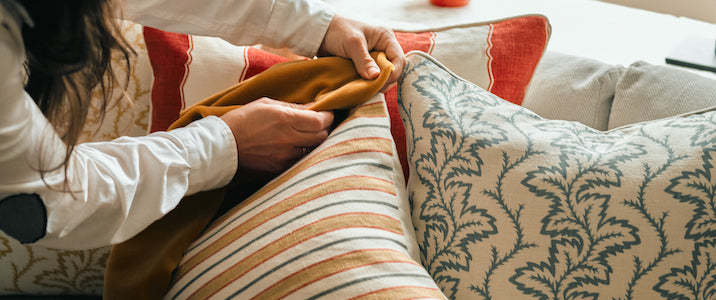
Our 'Reimagined and Repaired' furniture collaboration with Textile Designer Jessie de Salis is proof that great design doesn’t have to start new! We sat down with Jessie and talked more about our curated collection, and all things textile printing - from her design inspirations to her sustainable printing practices.

Photo: Jessie in her studio in Bristol
What does Second Hand September mean to you, and what made you want to be part of this project with Jules at Haines?
I had wanted to make a pitch to Jules for a while. I had an idea to screen print on some end-of-line recycled fabrics and create something from materials that already exist. So Second Hand September was the perfect project to develop this idea!
There are many sustainable choices we can all make when it comes to fabrics. Sourcing a natural fabric like linen, sourcing a fabric with clean and safe production practices, and sourcing a fabric with fewer air miles are all sustainable choices to be considered. However, sadly, everything we create from scratch will probably harm the planet somehow, even with the best of intentions. So I really wanted to start printing on fabric that already exists, giving it a new life. Instead of creating more things, why not reimagine the things we already have?
Why do you feel upcycling and reusing materials at home is important? Do you reupholster or repurpose fabrics in your own space, and if so, what do you love about the process?
As a nation, our connection to the land and to the things we consume has been somewhat lost. When we upholster an old chair, dye an old pair of white curtains, or paint an old table, it is not just about consuming less. We are also actively and creatively engaging with the materials and processes that make things. I think this connection is important. It makes us consume more consciously and reflect on the materials we use and where they come from.
I love it when people come to me with existing fabric to print on, such as old curtains or forgotten tablecloths. My cousin and I create an annual reclaimed collection. We have one rule: not to use anything bought new, including threads! It’s a great feeling to create a collection of cushions from a bunch of old zips and fabrics. Much of my own home is upcycled - I'm currently reupholstering some lovely Marcel Brouer chairs.

Photo: Jessie with a batch of screen-printed cushions
How did you decide on the colour palette for this fabric?
The print for this collection is created by layering rectangles to create a stripe by layering two colours. With screen printing, every colour is layered separately, so when you layer one colour over another (an overlay), you get a third.
Stripes play a central role in this collection - how did that come about?
So lots of my designs are bright, bold and colourful. A few interior designers told me my next collection should be much simpler and classic, to accompany the brighter, busier designs. I loved this idea and totally ran with it. The new collection, the Bando Collection, is about simple stripes, checks and squares. Hand printing creates subtle variations in colour. Like natural paint, the colours move and come alive.

Photo: Jessies 'Lino' fabric hanging in her studio
Can you share a bit about the printing process for this collection? What fabrics and dyes did you work with, and were there any techniques or sustainability considerations that were key?
Screen printing allows me to oversee the whole creative process. We only use linen (when bought new) - a fabric which has been used sustainably in Europe for centuries. All of our inks are water-based and screen printing uses very little energy. It’s amazing to print everything by hand. I feel connected to everything we create.
However, screen printing does require a lot of water to clean the screens, so we are developing a way to use collected rainwater. I work with my cousin Alice, who is a natural dyer and at the moment, we're creating a collection of fabrics made with naturally dyed inks.
Did you explore other design ideas along the way, or were stripes always the main focus?
So the design began with simple squares, Joseph Albers style. It was going to be squares with smaller squares layered over, but when I started playing around with printing these squares in one colour, a stripe emerged and I loved it. I thought it was so cool to have an overlaid screen-printed stripe.
In terms of design inspirations - my family is Swiss Italian, and I go to Northern Italy every summer. I love the warm Italian colours, the buildings, beach umbrellas and deck chairs, so I think this also influenced the design for this fabric!

Discover our curated collection of salvaged furniture, 'Reimagined and Repaired'.